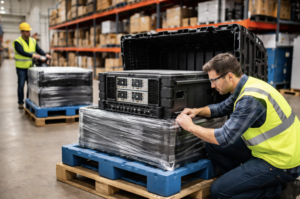
Sensitive IT equipment moves through a world that is far less forgiving than most people realize. Servers, network switches, storage arrays, edge devices, backup hardware, and related electronics are not just expensive. They are vulnerable to shock, vibration, static, moisture exposure, poor stacking, and careless handling at nearly every point in the supply chain. In an era when AI infrastructure, data center expansion, and hardware demand are growing fast, the protection of equipment during storage and transport has become more important, not less. Reuters has reported on rising demand for AI server infrastructure and the tightening market around related cooling and hardware systems, while AP has covered the growing scale and pressure surrounding data center buildouts.
That is where Mid-Duty Pallets become part of a smarter protection strategy. A pallet is not just a platform under a load. It is the base layer of physical risk control. When the pallet choice is wrong, the packaging above it is already compromised. When the pallet choice is right, it supports cleaner warehouse handling, more stable load distribution, safer rack storage, better forklift interaction, and more reliable movement through shipping channels. For companies that handle sensitive IT equipment, pallet selection directly affects damage prevention, operational consistency, and customer trust.
Why Sensitive IT Equipment Requires Better Handling Foundations
IT hardware is unusually exposed to small failures in logistics. A cracked housing, bent rail kit, crushed carton corner, moisture intrusion, or repeated vibration during movement can damage components long before a box ever looks destroyed from the outside. That makes physical handling standards far more important than many procurement teams initially assume. The broader material handling world recognizes that unit-load design and equipment choice are central to protecting goods during movement and storage, as outlined in Wikipedia’s overview of material-handling equipment.
This matters even more now because IT equipment is tied to a much larger infrastructure cycle. Reuters recently noted strong AI-driven demand for servers and related hardware, while the International Energy Agency has documented rising electricity demand connected to data centers and digital infrastructure growth. As organizations invest more heavily in computing hardware, the cost of preventable transport damage grows with it.
A mid-duty pallet fits an important middle ground. It offers more support and dependability than lighter platforms that may flex too much under concentrated equipment loads, but it is not automatically excessive for every shipment the way heavier solutions can be. That balance matters when companies want strength, stability, and repeatable performance without introducing unnecessary weight, waste, or cost into the shipping process.
How Mid-Duty Pallets Improve Stability for IT Shipments
One of the greatest threats to sensitive hardware is uneven load support. Many IT products are shipped in cartons that appear strong, but their internal protection depends on the base staying level and consistent. If the pallet beneath the cartons bows, splinters, or shifts under weight, the cushioning system inside the packaging loses effectiveness. Mid-duty pallets help reduce that risk by providing a more dependable platform for equipment that is neither extremely light nor suited to a flimsy base.
Stable pallet support also improves forklift and pallet jack handling. When the pallet is built for consistent performance, the operator is less likely to deal with awkward entry, drag, or sudden imbalance. That means fewer jolts at pickup, fewer misalignments during staging, and less unnecessary shock transferred into the load. In practical terms, that can make the difference between equipment arriving clean and equipment arriving with hidden internal stress.
This is especially important for businesses managing repeat shipments between warehouses, integration centers, corporate campuses, medical facilities, schools, and data center locations. Hardware often passes through multiple touchpoints before deployment. A dependable pallet reduces variability at each step, which is exactly what sensitive equipment needs.
Mid-Duty Pallets Support Better Load Integrity in Warehouses
Warehousing is not a neutral stage in the life of IT equipment. It is one of the places where damage risk quietly increases. Loads may be stacked, moved, restaged, wrapped, unwrapped, or placed in racks while waiting for deployment or final delivery. If the base is weak, load integrity degrades over time even when the cartons are never dropped.
Mid-duty pallets help preserve square, stable footprints for boxed equipment. That supports more consistent stretch wrapping, better corner protection performance, and improved vertical alignment. For IT environments where products may include fragile ports, internal boards, cooling elements, or precision-mounted drives, keeping the load settled and properly distributed matters far beyond appearance.
The IT equipment world is also increasingly shaped by supply chain visibility and risk management. Guidance from CISA on ICT supply chain risk management and its hardware bill of materials framework reflects how seriously organizations now take the integrity of hardware systems and their supporting supply chains. Physical logistics is part of that integrity conversation.
Protection Is Not Only About Cushioning and Boxes
Many businesses think the carton and foam inserts do all the protective work. They do not. Packaging performs best when the base underneath it behaves predictably. A well-chosen pallet complements the packaging system by minimizing avoidable movement and helping the load remain aligned through transport and storage.
This is especially true as equipment becomes denser, more valuable, and more thermally advanced. Reuters has reported on the growing importance of liquid-cooling systems and the pressure on suppliers serving high-density data center hardware. As the underlying equipment becomes more sophisticated, the cost of mishandling rises too.
Organizations protecting sensitive equipment should also think in layers. The pallet is one layer. The carton is another. Internal cushioning is another. Environmental controls matter too. The NIST Hardware Security program focuses on emerging hardware threats at the semiconductor and device level, reminding businesses that hardware protection is not only digital or theoretical. Real hardware has real vulnerabilities, and safeguarding it starts long before installation.
Why Mid-Duty Pallets Make Business Sense Beyond Damage Prevention
Damage reduction is the most obvious benefit, but it is not the only one. Better pallet performance can support operational consistency, improve handling speed, reduce repacking issues, and present a more reliable image to customers and partners. When a shipment arrives stable, clean, and properly supported, it reinforces trust in the supplier’s standards.
That matters for companies trying to build stronger Trust Flow, Citation Flow, and Domain Authority as well. High-authority content performs better when it reflects real operational knowledge and ties that knowledge to credible external references. Citing respected sources such as Reuters, AP News, the IEA, NIST, CISA, and the Uptime Institute signals that the article is grounded in the realities of today’s IT environment rather than generic logistics language. The Uptime Institute’s 2025 survey, for example, highlights ongoing pressures related to cost, power, availability, supply chain delays, and rapid technological change in digital infrastructure.
There is also a sustainability angle. Protecting equipment more effectively reduces waste, returns, and unnecessary disposal. The U.S. EPA’s electronics recycling information shows the environmental value tied to electronics recovery and reuse, which makes preventing damage in the first place even more meaningful. A better pallet strategy is not just about shipping performance. It is also about reducing avoidable loss across the equipment lifecycle.
A Stronger Logistics Standard for a More Demanding IT Future
The IT equipment landscape is getting more demanding, not simpler. Hardware is becoming more critical to business continuity, more expensive to replace, and more integrated into fast-moving digital infrastructure plans. Data centers are expanding, AI workloads are increasing, and organizations are paying closer attention to both cybersecurity and physical supply chain reliability. Those realities make seemingly basic decisions, including pallet selection, much more strategic than they used to be.
Mid-duty pallets deserve attention because they occupy a practical sweet spot. They help support sensitive equipment loads with more confidence than light-duty options, while still fitting the operational needs of many real-world warehouse and shipping environments. They create a stronger foundation for stable loads, cleaner handling, better packaging performance, and fewer preventable losses.
Conclusion
Protecting sensitive IT equipment begins at the ground level. Before a carton is wrapped, before a truck is loaded, and before a system reaches its destination, the pallet underneath the shipment is already shaping the outcome. Mid-duty pallets help create the stability, load integrity, and handling consistency that high-value hardware needs in today’s logistics environment.
As IT equipment demand rises and infrastructure grows more complex, companies that treat pallet selection as part of their protection strategy will be better positioned to reduce damage, strengthen operations, and deliver a more trustworthy experience. For businesses moving sensitive electronics, mid-duty pallets are not a small detail. They are a smart operational decision that supports both equipment protection and long-term credibility.